
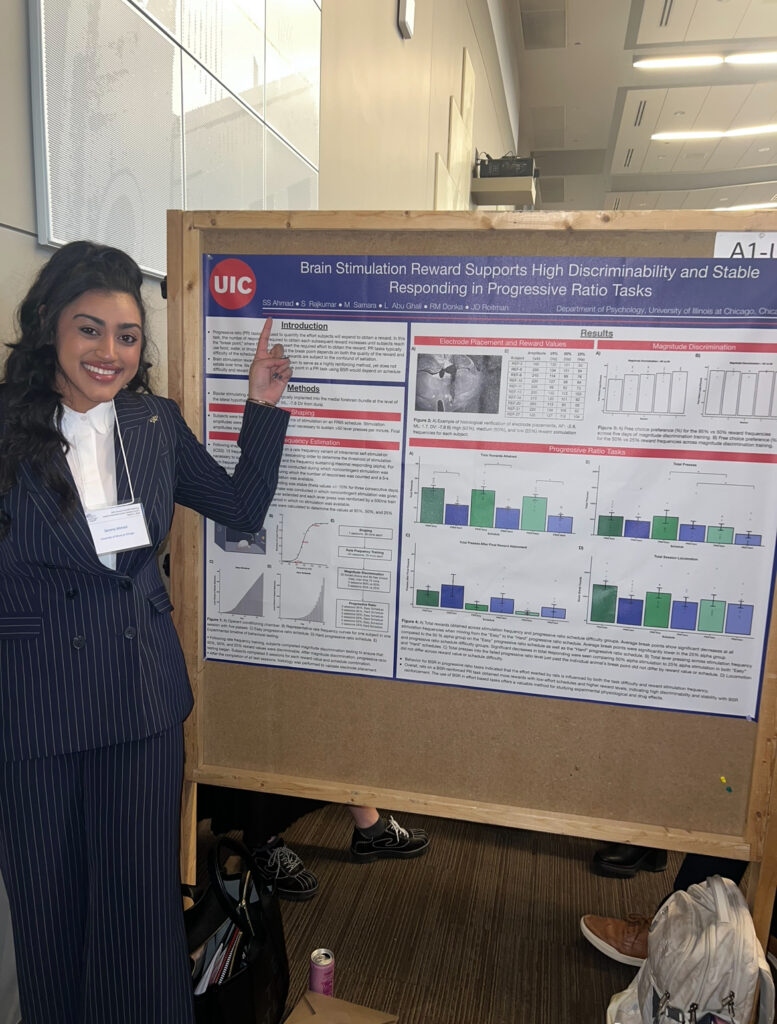
Brain stimulation reward supports discriminability and stable responding in progressive ratio tasks
Presented at 2024 Chicago Society for Neuroscience Research Conference at Loyola University and Spring 2024 University of Illinois Chicago Honors College Research Symposium

Abstract
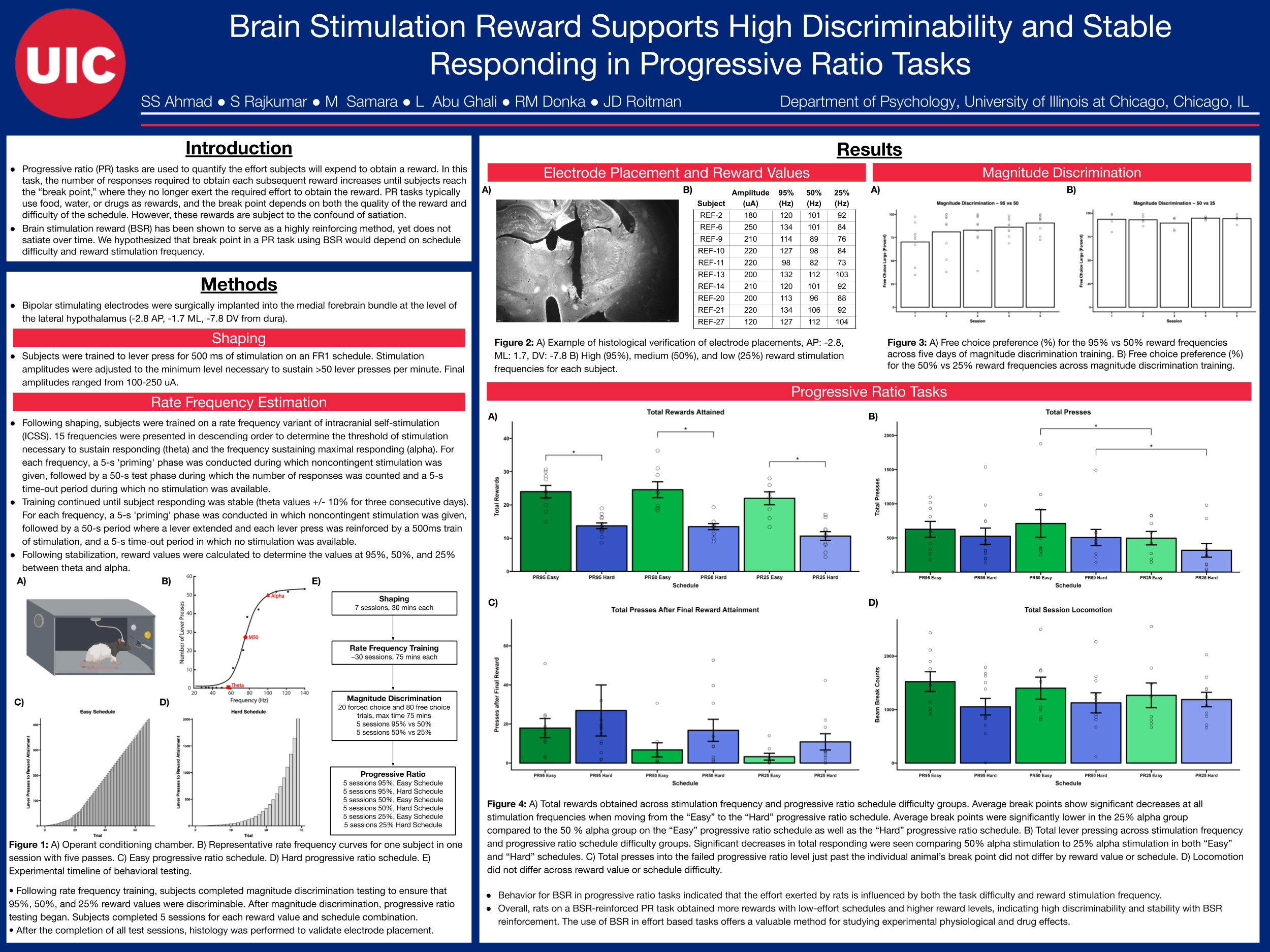
Progressive ratio (PR) tasks are used to quantify the effort subjects will expend to obtain a reward. In this task, the number of responses required to obtain each subsequent reward increases until subjects reach the break point, where they no longer exert the required effort to obtain the reward. PR tasks typically use food, water, or drugs as rewards, and the break point depends on both the quality of the reward and difficulty of the schedule. However, satiation may confound the measurement of motivation for reward. Brain stimulation reward (BSR) has been shown to be highly reinforcing yet does not satiate over time. We hypothesized performance on a BSR-reinforced PR task would depend on both the difficulty of the schedule and the reward stimulation frequency. Male and female Long Evans rats were implanted with bipolar stimulating electrodes targeting the medial forebrain bundle at the level of the lateral hypothalamus. Following recovery, subjects were shaped to lever press for stimulation on an FR1 reinforcement schedule, then trained on a rate-frequency variant of intracranial self-stimulation to identify threshold (theta) and maximum responding (alpha) frequencies. Reward frequencies for PR were calculated as 95%, 50%, and 25% of alpha. Rats were then tested on a PR task using three reward levels (95%, 50%, or 25% of alpha) and two schedules (low or high effort). The amount of effort rats expended in the PR task was dependent on both the difficulty of the schedule and the reward stimulation frequency. For all reward levels, more rewards were obtained for the low effort schedule compared to the high effort schedule. Across reward frequencies, we saw no difference in the number of rewards obtained for 95% and 50% reward level. However, rats obtained fewer rewards on both schedules for the 25% reward. Overall, BSR is a highly discriminable and stable reward when used in PR responding. The use of BSR in PR tasks avoids issues with other reinforcers while supporting a high level of discrimination and motivated behavior, and can serve as a valuable method to test the effects of physiological and drug manipulations on performance in effort-based tasks.